In MalariaWorld this week there is a study investigating the people’s opinion about malaria and its treatment in Ethiopia. In ‘The social experience of malaria treatment-seeking: pathways, gender, and inequality in Jimma Zone, Ethiopia’, Gerba et al interviewed people and conducted focus group studies on malaria and its treatment. While it is clear that the researchers are strong believers in the mosquito transmission hypothesis, the interviewees consider other causes to be more important. And they rely on traditional remedies as a first response.
Local terms for malaria, busa (seasonal fever), sekera (killer disease) and buda (evil eye), are related to how symptoms were recognized and interpreted.
Busa was widely used to refer to recurrent seasonal fevers, particularly those occurring during the rainy period. Many participants associated busa with environmental and seasonal changes rather than with mosquito bites. One woman explained: “Every year when the rains come, busa also comes. The children fall sick one after the other”. In western countries such an illness would be considered a cold or flu (on in 2020-2022 COVID19). Many households initially adopted a ‘wait-and-see’ approach before seeking biomedical care with this illness.
Sekera is a severe or life-threatening forms of illness, characterized by high fever, intense chills, weakness, and loss of speech. For many, the experience of sekera was not just a biological state but a state of total social paralysis; one participant noted that the illness: “Finishes a person”, and is associated with sudden deterioration and a high risk of death. Illness episodes labeled as sekera are treated with greater urgency and fear, often prompting families to seek stronger forms of intervention.
Buda was linked to spiritual harm, envy, and the evil eye. Some participants believed that malaria-like symptoms could result from social tension or spiritual attack rather than physical causes alone. An elderly woman explained “Malaria is not only about mosquitos. It is like buda; it comes when someone envies you, when your body is not protected. If it catches you, it can finish you”. In such cases, illness was understood not merely as a physical condition but as a reflection of social vulnerability.
Treatment usually begins with hot beverages and OTC medications. If symptoms worsen traditional herbal remedies would be used. Spiritual practices such as the use of holy water and prayer are used. If symptoms get very bad medical care at a clinic would be sought.
The authors reference similar observations in other African studies. In Ghana, Tanzania, Kenya, Burkina Faso, Uganda, and Malawi communities frequently use locally meaningful fever terms that do not neatly correspond to biomedical classifications. However, in the medical establishment the belief in the mosquito tall tale continues irregardless.
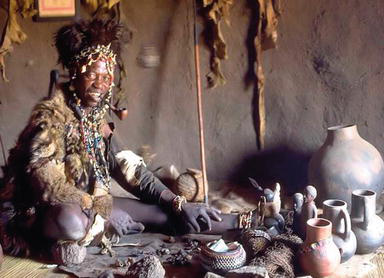
Picture. Spiritual healer or Sangoma from South Africa (Source—Ancient Origins).