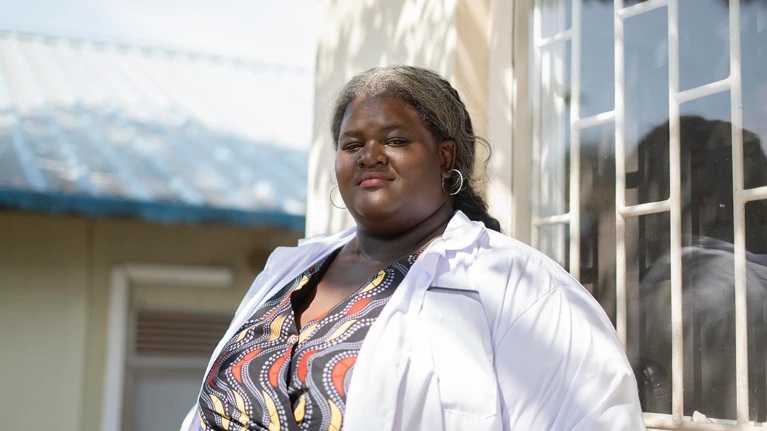
A blog post in Nature highlighted in MalariaWorld this week features an African scientist working on genetically modified mosquitos. ‘The Ugandan scientist taking aim at malaria’s mosquitoes’ by Desmond Thompson is Ugandan entomologist Krystal Mwesiga Birungi (pictured). The article is part of a series on Young African Scientists to Watch, commemorating the fifth anniversary of Nature Africa
Birungi works with Target Malaria, whose work in Burkina Faso was discussed in August and September 2025 when their field research was stopped by Ibrahim Traore. She works at the Uganda Virus Research Institute in Entebbe. The article describes her childhood experiences of contracting the illness and the serious bout than nearly killed her younger brother. She became interested in science as a result and studied zoology and botany at Makerere University. Now she works for Target Malaria who is developing genetic technologies to modify malaria-transmitting mosquitos. Our scepticism of this proposed method to combat malaria was also discussed in July and February of this year.
Birungi worries about growing insecticide resistance of mosquitos and changing mosquito behaviour – biting outside when people are not under nets. She also worries that the parasite is becoming less susceptible to frontline drugs.
Target Malaria is investigating genetic approaches designed to suppress populations of malaria-transmitting mosquitos. One strategy uses gene drive to spread a genetic modification that disrupts female fertility, so that females inheriting two copies become sterile, thus gradually reducing populations of the malaria-transmitting insect. This idea makes very little sense in terms of Darwinian evolution theory. Mosquitos produce many eggs and are restricted by larval and adult food sources. Reducing fertility will have little long-term effect. More offspring of unaffected animals will survive instead.
She discusses the interesting science. CRISPR gene-editing technology provides a mechanism for making such targeted changes to DNA. It uses a specially designed guide RNA molecule to locate a specific sequence in the genome and an enzyme to cut the DNA at that point, allowing scientists to introduce the desired modification very precisely.
Researchers introduce the genetic material and editing machinery into mosquito embryos using extremely fine needles under a microscope. This must be done shortly after the eggs are laid, when the embryos are at the right stage of development, which requires a very steady hand to inject a specific part of the egg without damaging it.
Birungi calls for more of this research to be carried out in Africa. Much of the funding has gone to institutions in the Global North. She calls for more involvement of women. In 2025, she was named a Gates Foundation Goalkeepers Child Health Champion and selected for the 2025–26 Obama Foundation Leaders Africa programme.
We agree with Birungi who rejects the notion that malaria must remain an unavoidable fact of African life. However, we feel that to eliminate malaria more emphasis should be placed on nutrition and hygiene than on exotic ‘bug-hunting’.