An interesting article referenced in MalariaWorld this week found that household net use showed no significant association with malaria of children under five (CU5) after controlling for wealth index. ‘Risk factors for malaria among children under five living in net-owning households in Mozambique from the 2022–3 Demographic and Health Survey’ by Mooney et al examined household-level mosquito net use in Mozambique using 2022–3 national survey data.
The study published in Transactions of The Royal Society of Tropical Medicine and Hygiene, has results clearly stated in the abstract. Household net use showed no significant association with CU5 malaria after controlling for wealth index. Wealth index indicated a dose-response, where middle-resource households were 43% less likely (adjusted OR [aOR] = 0.57; 95% CI 0.38 to 0.84; P < .0048) and highest-resource households were 84% less likely (aOR = 0.16; 95% CI 0.09 to 0.27; P < .0001) compared with lowest-resource households.
Many studies continue to be published that claim a benefit from net use including in MalariaWorld this week. ‘Prevalence and factors associated with malaria amongst under-five children in Senga Hill District, Northern Province, Zambia, a community-based cross-sectional study’ by Arthur et al found that correct hanging of an ITN reduced the odds of being positive for malaria by 88%. And having two insecticide treated nests (ITNs) and indoor residual spraying (IRS) done in the last spraying season reduced odds of being malaria positive by 86%. These are similar percentage reductions to those seen in the Mooney study for the highest resource households.
However, the Arthur study did not analyse family wealth. To repeat the well know experimental axiom, correlation does not imply causation. The Mooney paper also states Causation cannot be inferred from a cross-sectional survey. They state that the findings are consistent with prior studies suggesting that wealthier households may benefit from improved housing conditions, access to healthcare and malaria- prevention resources.
In general wealthier families are more likely to buy mosquito nets and pay for insecticide spraying. Wealthier families are less likely to have children under five with malaria. But that does not imply that nets or insecticide spraying reduce the incidence of malaria. The cause of the decreased malaria could be the result of some other factor related to wealth. Wealthier families can afford better food, cleaner water, better built houses, and better sanitation. Could one or all of these factors be the reason for reduced malaria?
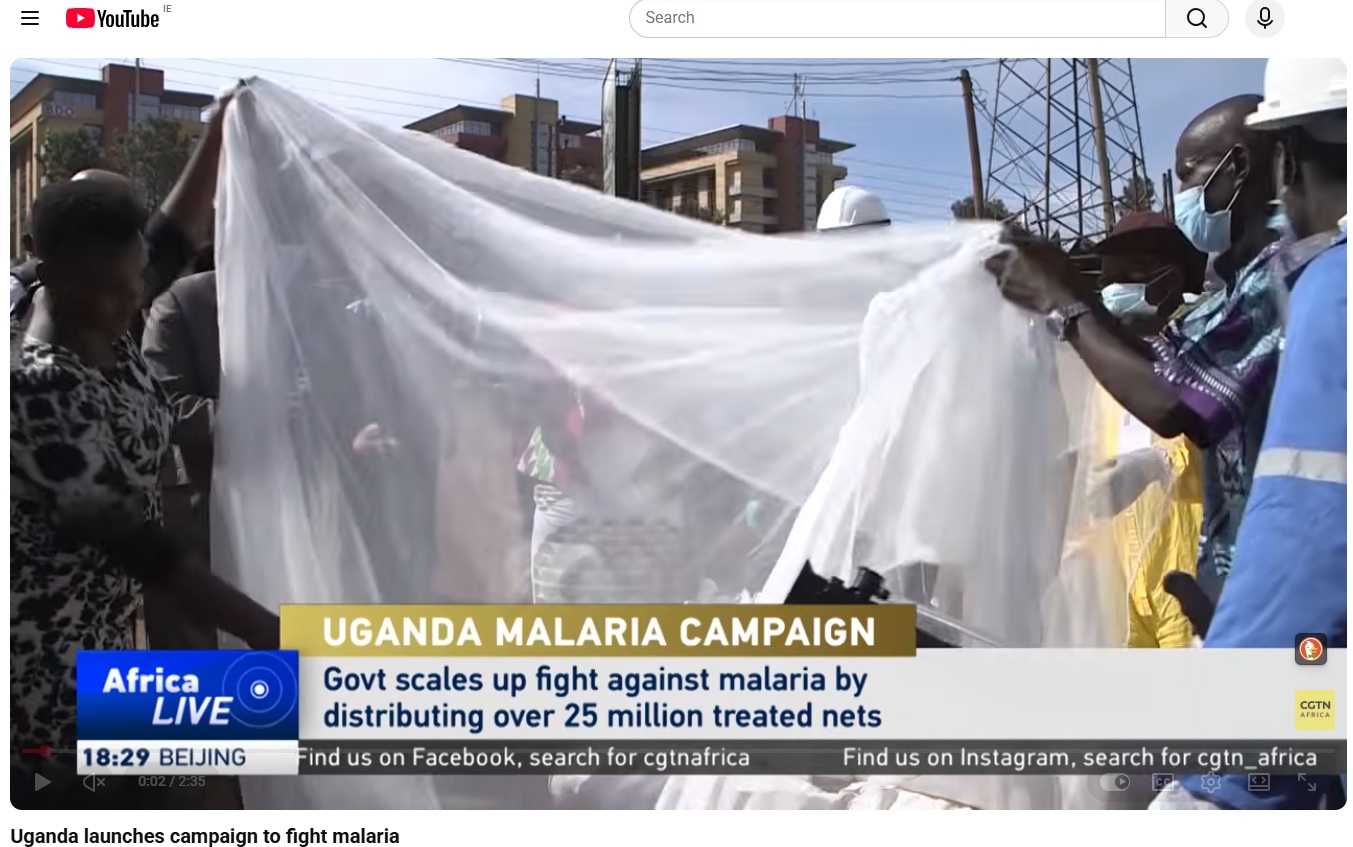
Despite the unconvincing evidence of their effectiveness nets continue to be promoted. A YouTube video reported in MalariaWorld this week by CGTN describes a government supported net distribution scheme in Uganda.
Originally posted April 17. Revised April 20.
https://usmalaria.com/nets-ineffective-at-preventing-malaria-but-are-promoted-anyway/