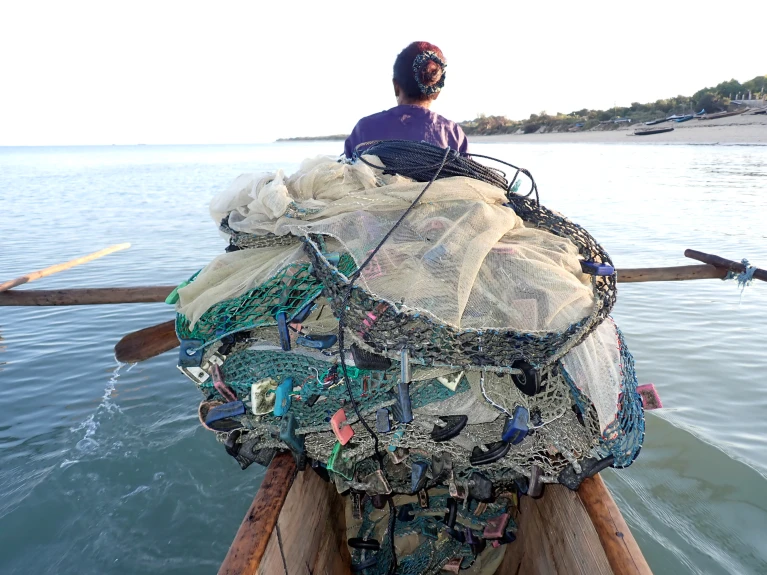
The mass distribution of free insecticide treated nets (ITNs) is not immune from the law of unintended consequences. In MalariaWorld this week there is a news article from Nature called ‘The catch in repurposing malaria nets’. A study in southwest Madagascar shows how repurposed bed nets provide food and income to coastal households, while raising concerns about juvenile catches and the future of local fisheries.
More than three billion insecticide-treated mosquito nets have been distributed globally since 2004, with the majority received in sub-Saharan Africa over the past two decades. Fishers using repurposed mosquito nets in southwest Madagascar can land between 9 and 18 kilograms of fish in a single trip. A new study found that their catches contained hundreds of different forms of marine life, many of them only a few centimetres long. Their efficiency raises difficult questions about the future of the fisheries on which those communities depend.
Mosquito-net fishing, using discarded or new nets, has been documented across much of tropical Africa, including Kenya, Madagascar, Uganda and Tanzania. Conservationists have long argued that the practice can damage fisheries by capturing juvenile fish and other marine organisms before they reproduce. Around Lake Victoria in western Kenya, mosquito nets are used for fishing, but they have also been repurposed to protect crops, cover chicken coops, make ropes, football goals and even wedding veils.
More than half the fishers surveyed reported using mosquito nets because they had few alternatives. The very fine mesh allows the capture of a wide range of marine organisms, including small fish and shrimp, often with relatively little effort and without the need for specialised equipment.
Researchers found that fishers generally used old or surplus mosquito nets, meaning that bed-net coverage did not differ significantly between households that fished with mosquito nets and those that did not. Unlike conventional fishing gear, conservation scientists are concerned that insecticide-treated nets could have health risks to fishers or consumers.
“If unaddressed, we risk reduced effectiveness of malaria interventions, ecological damage to fish stocks and worsening public health outcomes in the next 10 to 20 years,” says Gabriel Dida, a public health researcher at Maseno University in Kenya.
What is not mentioned in the article is the unintended consequence of the damage that the free net distribution does to the business of traditional net makers, who hand make coarser nets that would not catch the juvenile fish. Why pay a local when the ‘do gooders’ give for free?
And as we have pointed out earlier (April 2025, November 2025, February 2026, April 2026) ITNs are not even effective at preventing malaria.